Stop Buying at Spot: A Stacker's Playbook for Cutting Premium, Tax, and Shipping Drag
Spot is not your cost basis. Here's how stackers quietly leak 10–15% on every purchase — and the buying discipline that fixes it.

I have a friend who used to trade EUR/USD at a bank desk. Million-dollar tickets, all day, every day. He once spent the better part of a morning complaining about a half-basis-point spread — that's 0.005% — he felt his counterparty was sneaking onto his fills.
A week later he asked me about buying his first gold coin. He walked into a high-street dealer, paid an 8% premium, ate 20% VAT on the silver he picked up alongside it, and tipped a flat shipping fee on a small order. He didn't blink. The same person who would agonise over a half-bip spread on a screen accepted double-digit drag on his physical metal without a second thought.
He's not unusual. Most stackers do exactly this. They watch the spot price like it's a stock ticker, get excited when it dips a couple of percent, then click “buy” and quietly give the entire dip back — plus some — in premium, tax, and shipping at the checkout page.
If you stack regularly, the gap between buying with discipline and buying on impulse compounds into something serious. Over a decade of consistent stacking, it's the difference between a stack that hit your accumulation target and one that quietly missed it.
Your Real Cost Basis Is Not Spot
The number that actually matters when you buy physical metal is not the spot price. It's the all-in cost per gram delivered to your door.
Roughly:
(spot × ounces × (1 + premium) × (1 + tax) + shipping) ÷ total grams = your real cost per gram
Spot is the mid-market wholesale quote. It's relevant to bullion banks and futures desks. As a retail stacker, you never transact at spot — not once, not ever. Your fill price is always higher, and the gap between the two is where most stackers quietly lose ground.
Once you start logging every purchase using something like that formula, two things happen. You stop celebrating spot dips you immediately give back at checkout. And you start optimising the three variables you actually control: premium, tax, and shipping.
Set a Premium Ceiling Before You Shop
Decide your maximum acceptable premium for each product category before you open a dealer's website. Write it down somewhere. Then refuse to buy above it, even if spot looks attractive.
Reasonable working ranges in normal market conditions look something like this:
- Common 1 oz gold coins and bars: roughly 3–6% over spot.
- Sovereign gold coins (Britannias, Sovereigns, Eagles, Maples): roughly 4–8% over spot — though the tax treatment in your jurisdiction may justify the extra.
- 1 oz silver bars and generic rounds: roughly 15–25% over spot.
- Sovereign silver coins: 25–45% over spot in normal markets — sometimes much wider during squeezes.
- Fractional gold (1 g, 2.5 g, 5 g): noticeably higher per-gram premium — usually only worth it for gifting or a specific liquidity reason.
When premiums blow out — supply squeezes, retail panic buying, product-specific manias — sit on your hands. A trader doesn't chase price into a widening spread. The metal will still be there next month at a more reasonable mark-up. Discipline at the premium line is most of the game.
Amortise Shipping by Sizing Up
Shipping is your transaction cost. Treat it the way an FX trader treats commission.
A flat $15–25 shipping fee on a $200 order is a 7–12% drag — it might as well be another tax. On a $2,000 order the same fee is under 1%.
If you have a $200 monthly stacking budget, you really have two options. You can buy every month and bleed double-digit shipping drag every time. Or you can stack the cash for three or four months, place one larger order, and crush the same shipping cost down to roughly 1–2% of the order value. The second approach is dramatically better mathematically — but only if you actually have the discipline to wait. This is one of the few moments where holding cash is a positive-expected-value move for a stacker.
A simple rule: if shipping is $20, wait until you can place at least a $1,000 order to keep that line under 2%. The arithmetic is the same in any region. UK and EU buyers face it. Stackers in the GCC paying for international delivery feel it more sharply once customs handling and any duties enter the picture.
Build Your Core From the Cheapest Metal You Can Find
Same metal, very different premiums. A 10 oz cast bar carries a fraction of the premium of an equivalent weight in sovereign coins. The metal — the actual gold — is identical.
A workable framework most disciplined stackers settle into looks roughly like this:
- Core position (70–80% of the stack): the lowest-premium product available in your market — generic rounds, cast bars, or whichever product trades closest to spot at your usual order size.
- Liquid sovereign position (15–25%): government-minted coins, for recognition and easy resale.
- Speculative or numismatic (0–10%): only if you genuinely understand that market and have a thesis you'd defend.
Most stackers invert this without realising it. They build their stack from sovereigns and limited-mintage products, paying high single-digit premiums on every gram. Over ten years of consistent stacking, that drag compounds into a meaningful shortfall in actual metal accumulated.
The takeaway is simple. Pay sovereign-coin premiums when there's a reason — recognition for resale, favourable tax treatment in your jurisdiction, or a specific liquidity need. Don't pay them by default.
Tax Jurisdiction Is Free Alpha
This is the variable most stackers under-optimise, and it's the cheapest one to fix. Every region has structural tax quirks baked into its bullion rules. Spending an hour learning yours is probably the highest-ROI hour you can spend on stacking education. A few common ones — rules change, so verify before you buy:
United States. Roughly 40 states currently exempt some form of investment-grade bullion from sales tax, often subject to a per-transaction threshold (anywhere from a few hundred dollars to $1,500+ of qualifying bullion, depending on the state). Where bullion is taxed, some online dealers ship from warehouses in tax-friendly states — the destination state usually controls. Saving 4–9% on every order is alpha that requires zero investing skill, just five minutes on your dealer's shipping policy page.
United Kingdom. Investment gold is VAT-exempt by default — that's the easy win. Silver carries 20% VAT, which is brutal and is the reason many UK silver stackers route into VAT-free offshore vaulting instead of taking domestic delivery. For gold, look hard at CGT-exempt coins like Britannias and post-1837 Sovereigns. Because they are UK legal tender, gains on resale are exempt from Capital Gains Tax entirely — no annual allowance to chew through, no calculation. For larger stackers that exemption is enormously valuable compared to bars or foreign coins that don't qualify.
UAE & Saudi Arabia. Both apply 0% VAT to investment-grade gold (typically 99% purity or higher) under specific conditions. Premiums in established physical souqs can run lower than Western online prices for standard bars and coins, but workmanship fees on jewellery-grade pieces can swallow the entire spot-driven case for buying. Regional stackers should prioritise bars and coins from licensed refiners, avoid jewellery-style pieces unless ornamentation is the point, and check that any cross-border purchase qualifies for the relevant VAT exemption on import.
Wait for Confluence, Not for Spot
The biggest mistake most stackers make is buying when one thing looks attractive — usually a spot dip — while ignoring everything else.
The buy signal isn't spot. It's confluence:
- Spot has pulled back from recent highs.
- Premiums on your target product are at or below your ceiling.
- The order size keeps shipping cost amortised below ~2%.
- The order qualifies for a tax exemption in your jurisdiction.
- (Bonus) a free-shipping promotion or stackable dealer discount is on the table.
When all of those line up, you fill. When only one or two do, you wait. That requires patience, and it's genuinely hard the first few times you do it. But it's the entire difference between stacking with discipline and stacking on emotion.
A Worked Example
Two stackers. Both deploy roughly $6,000 over twelve months. Same spot prices, same metal, very different outcomes.
Stacker A buys $500 of 1 oz sovereign gold coins every month from a dealer charging a 7% premium. Their state taxes bullion at 6%. Shipping is a flat $20.
Of every $500 spent, only about $423 ends up as gold-at-spot value — the rest is premium, tax, and shipping. Over twelve months that's roughly $5,080 of metal for $6,000 spent.
Stacker B stacks cash for three months at a time, places four $1,500 orders into a tax-exempt configuration, and buys lower-premium cast bars at a 4% premium. Shipping is the same flat $20 — but now amortised across a much larger order.
Of every $1,500 spent, about $1,423 ends up as gold-at-spot value. Over twelve months that's roughly $5,690 of metal for the same $6,000 spent.
Stacker B ends the year with about 12% more gold — for the exact same total cash outlay. Repeat that discipline for ten years and the gap is no longer a rounding error. It's the difference between hitting your accumulation target and missing it by a wide margin.
The Hard Part: Actually Keeping the Ledger
None of this works if you don't actually log every fill and track your running all-in cost per gram. Without the ledger you are, with respect, a tourist convincing yourself you got a deal. With it you have the only metric that matters when it's eventually time to sell — or when someone you trust asks whether stacking has actually worked out for you.
A simple spreadsheet works. So does any tool that tracks all-in cost per gram delivered across purchases — which is precisely the buying-intelligence layer we're building into BullionCoin Network. Your spot price isn't your cost basis. Your delivered, all-in, tax-and-premium-inclusive cost is.
Start tracking that number. Set your premium ceilings. Wait for confluence. Stop buying on emotion.
The metal isn't going anywhere. The drag costs you absorb on every impulsive purchase, however, are gone forever.
Curious what consistent buying actually delivers when you let it compound? See our 10-year DCA backtest using real LBMA spot data.
Track Every Fill. Know Your Real Cost Basis.
BullionCoin Network logs every purchase with premium, tax, and shipping — so you always know your true cost per gram, not just the spot price on the day.
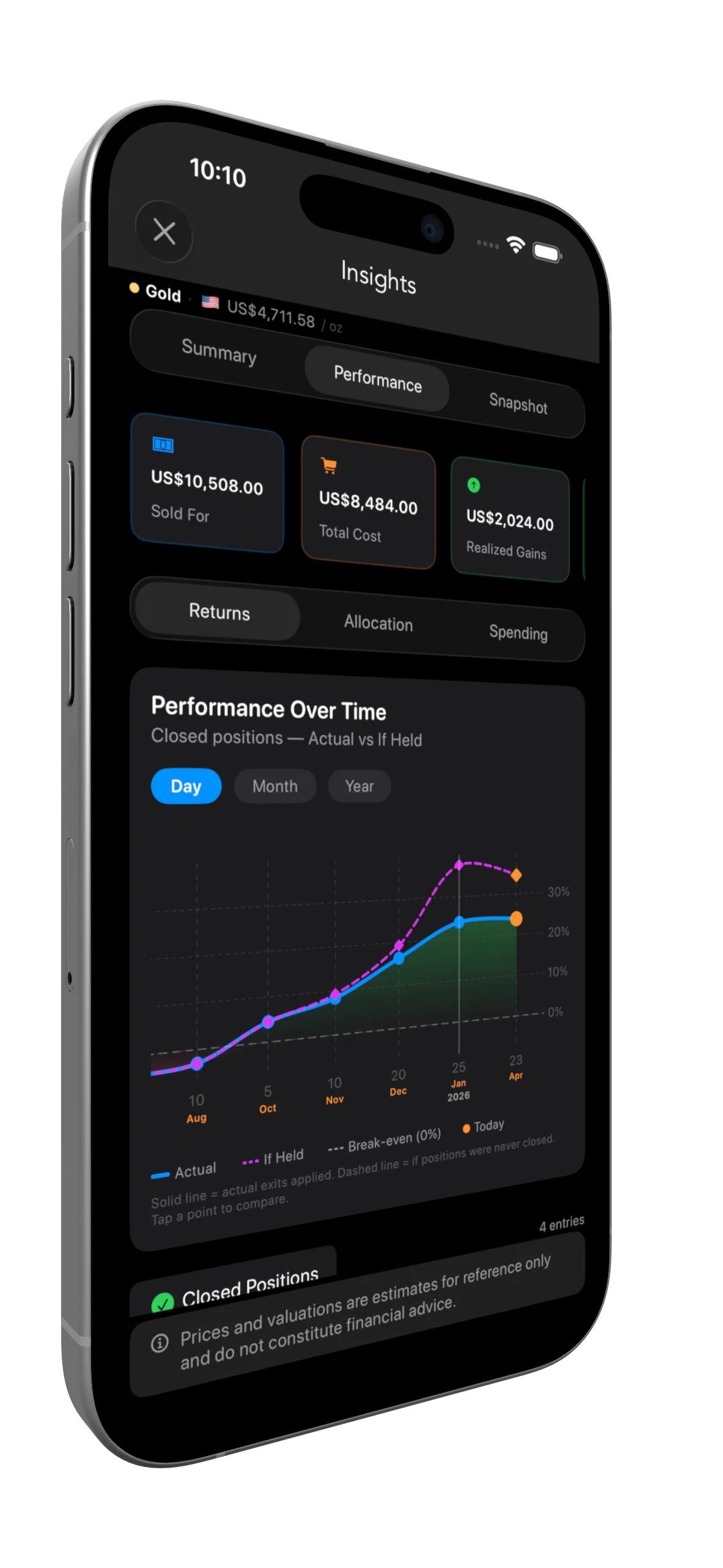
Portfolio Performance
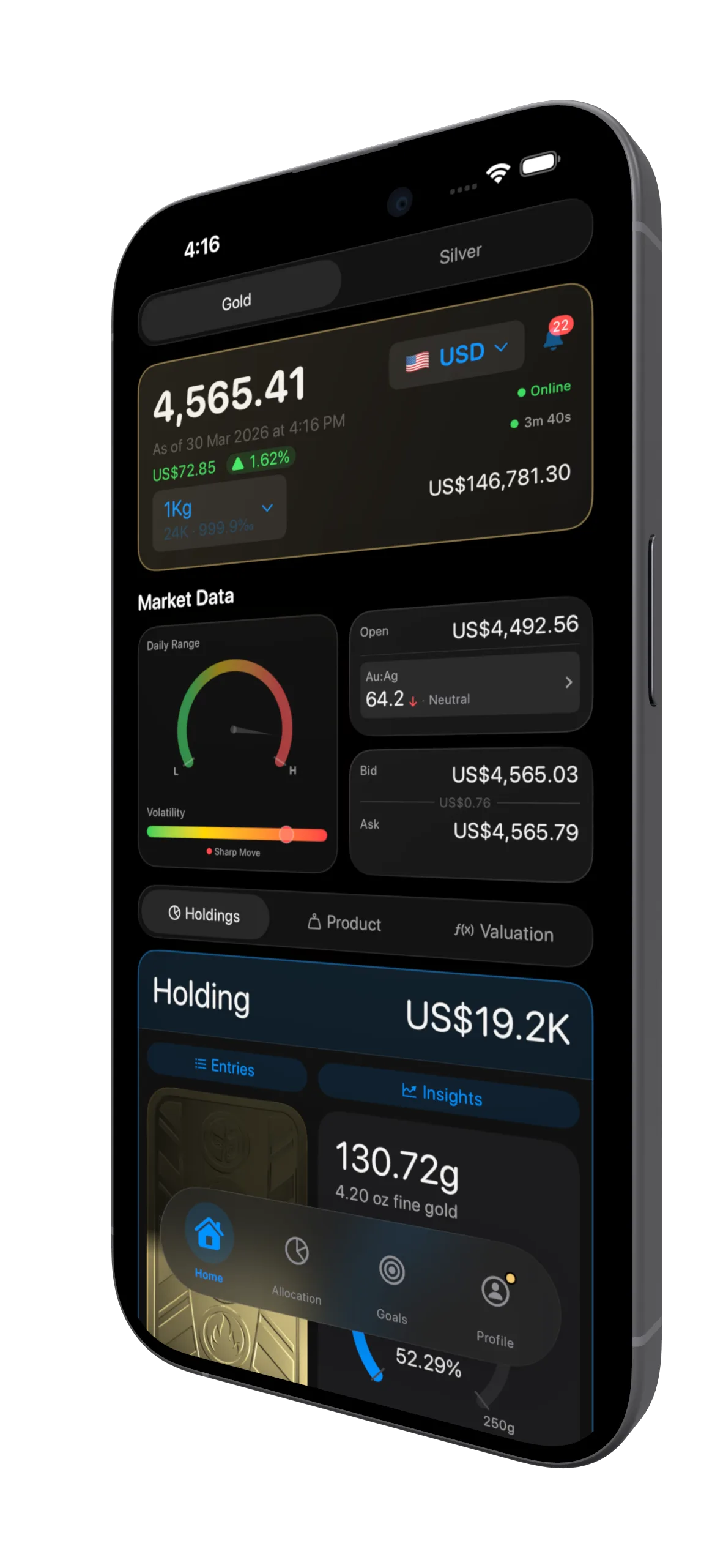
Live Spot Prices
Premium, tax, and shipping figures in this article are illustrative working ranges based on common retail dealer pricing in early 2026 and on publicly available tax rules in the jurisdictions named. Specific exemptions, thresholds, and rates change frequently and vary by state, region, and product classification.
This is educational content, not financial, investment, or tax advice. Verify current bullion VAT, sales-tax, and CGT rules with a qualified professional in your jurisdiction before making purchase decisions. Past performance does not guarantee future results.