Everyone Wants to Buy Gold at $1,800. Nobody Wanted to Buy Gold at $1,800.
Hindsight makes every previous price look like a gift. Here's why that feeling keeps you on the sidelines — and what to do about it.

Gold is trading above $5,000 an ounce. And somewhere on the internet, right now, someone is typing: “I wish I'd bought when it was $1,800.”
Fair enough. $1,800 gold looks like a screaming deal from here. But here's the part they always leave out: when gold was $1,800, almost nobody wanted it.
That's not speculation. You can go back and read the forums, the comment sections, the Reddit threads from late 2022. The sentiment was ugly. Crypto was the future. Gold was a “boomer rock.” The Fed was going to tighten forever. And the people who were buying? They were getting told they were wrong.
This pattern has repeated at every major gold low for the past 25 years. And it will repeat at the next one. Understanding why is the difference between building a real stack and perpetually waiting for a price that only looks good in retrospect.
What $1,800 Gold Actually Felt Like
Let's rewind to late 2022. Gold had been stuck in a range for over two years. It peaked near $2,075 in August 2020 during the pandemic rush, then spent 28 months drifting lower. By September 2022, spot hit $1,622. By November, it was clawing back toward $1,750.
Here's what the world looked like at that price:
- The Fed had hiked rates from 0% to 4% in nine months and signaled more hikes coming.
- The dollar index (DXY) was near 20-year highs. Every pundit said strong dollar = weak gold.
- Crypto hadn't collapsed yet — FTX was still a “top exchange” and the money was flowing into digital assets, not metals.
- Gold ETF holdings were declining. Institutional money was leaving.
The narrative was straightforward: gold doesn't work in a rising-rate environment. Why would you buy a non-yielding asset when T-bills pay 4%?
That was the consensus. And the consensus was dead wrong.
From that $1,622 low, gold went on a run that nobody in mainstream finance predicted: $2,000 by early 2023, $2,400 by mid-2024, $3,000 by year-end, and past $5,000 by early 2026. The people who bought the “boomer rock” at $1,800 are sitting on a 170%+ gain. The people who were waiting for a better entry are still waiting.
This Isn't New. It Happens Every Cycle.
The hindsight pattern is remarkably consistent:
- $250/oz (1999): Gold was at a 20-year low. The Bank of England was literally selling its reserves. The financial press called gold a “barbarous relic.” Everyone who bought at $250 is up 1,900%+ today.
- $700/oz (2008): The financial crisis tanked everything, including gold temporarily. Fear of deflation. Margin calls forcing liquidation. Buying gold during a liquidity crisis felt insane. It doubled within three years.
- $1,050/oz (2015): Four years of decline from the 2011 high. The “gold bubble popped” narrative was universal. The dollar was strong. Nobody cared. Gold tripled in the next eight years.
- $1,620/oz (2022): Rising rates, strong dollar, crypto mania. “Gold is dead.” We covered this one. Gold tripled.
See the pattern? Every price that looks obvious in hindsight felt terrible at the time. That's not a coincidence. It's the mechanism.
Gold gets cheap when nobody wants it. That's what cheap means. If sentiment were bullish and demand were high, the price wouldn't be low. The only way to buy at the bottom is to buy when everything around you is saying don't.
Your Brain Is Working Against You
There's a name for this: hindsight bias. It's the tendency to look at past events and believe they were predictable — even when they weren't. In behavioral economics, it's one of the most well-documented cognitive biases.
But there's a nastier cousin that does the real damage: anchoring. Once you've seen a lower price, your brain locks onto it as the “real” price. Everything above it feels expensive. Everything below it feels like a crisis.
This creates a permanent paralysis:
- You won't buy at $5,000 because you remember $3,000.
- You wouldn't buy at $3,000 because you remembered $1,800.
- You wouldn't buy at $1,800 because you remembered $1,200.
There's always a lower price in the rear-view mirror. And so you never buy. Five years pass. Gold is at $7,000. And you're still typing “I wish I'd bought at $5,000” into a forum.
This isn't a gold problem. It's a decision-making problem. And the only cure is a system that removes the decision entirely.
The System That Makes Hindsight Irrelevant
Dollar-cost averaging doesn't require you to predict bottoms. It doesn't require conviction at the right moment. It doesn't require you to override your instincts when everything feels wrong.
It requires one thing: the same amount, on the same schedule, regardless of price.
When you DCA, you automatically buy more grams when prices are low and fewer when prices are high. The math does the work. You don't need to “call the bottom.” You just need to not stop.
Our 10-year backtest showed that a fixed-dollar buyer achieved a lower average cost per gram than a fixed-weight buyer over 121 months — and both strategies crushed the person who sat on the sidelines waiting for “the right time.”
The person who bought $100/month at $1,800 gold, at $2,400 gold, and at $3,200 gold has a blended cost per gram well below today's price. The person who kept waiting for $1,800 to come back owns zero grams.
Zero grams at the “perfect” price is still zero grams.
“But Gold Is Expensive Right Now”
Yes, $5,000 gold feels expensive. Just like $1,800 felt expensive if you remembered $1,200. Just like $700 felt expensive in 2007 if you remembered $280.
Every price feels expensive compared to the one before it. That's what an uptrend looks like when you're inside it.
The question isn't whether gold is expensive. The question is whether the reasons you buy gold have changed. Is the global debt load shrinking? Are central banks selling their reserves? Has fiat currency become harder to debase?
If the answer is no — and as of this writing, it largely appears to be — then the structural case that many analysts cite for gold remains intact. Central banks bought over 1,000 tonnes in each of the last three years. Whether that trend continues is an open question — but the demand so far has been real.
The Rear-View Price Illusion
The price people wish they'd bought at will always be in the past. It was $250, then $700, then $1,200, then $1,800, then $3,000. If gold continues its long-term trend, today's price may join that list too.
For those who have decided that physical gold belongs in their savings, the historical pattern suggests that the price rarely “feels right” in the moment. One common approach is dollar-cost averaging — a fixed monthly amount, regardless of spot price — which removes the emotional timing decision entirely.
That said, gold is not appropriate for every financial situation. Whether and how much to allocate is a personal decision that depends on your goals, timeline, and risk tolerance.
Start Building. Track Everything.
BullionCoin Network logs every purchase, tracks your average cost per gram, and keeps your stack visible against live spot prices — so you can see your discipline compounding in real time.
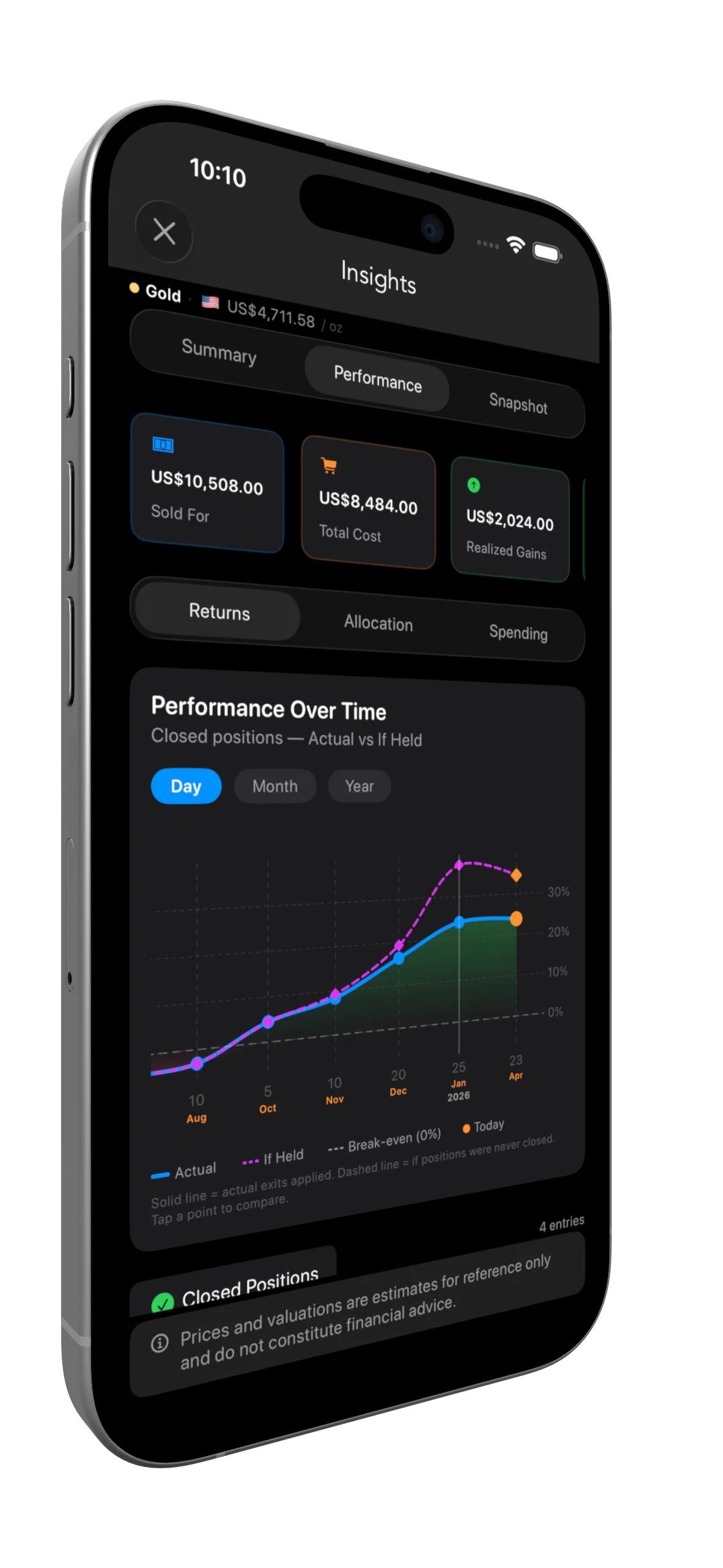
Portfolio Performance
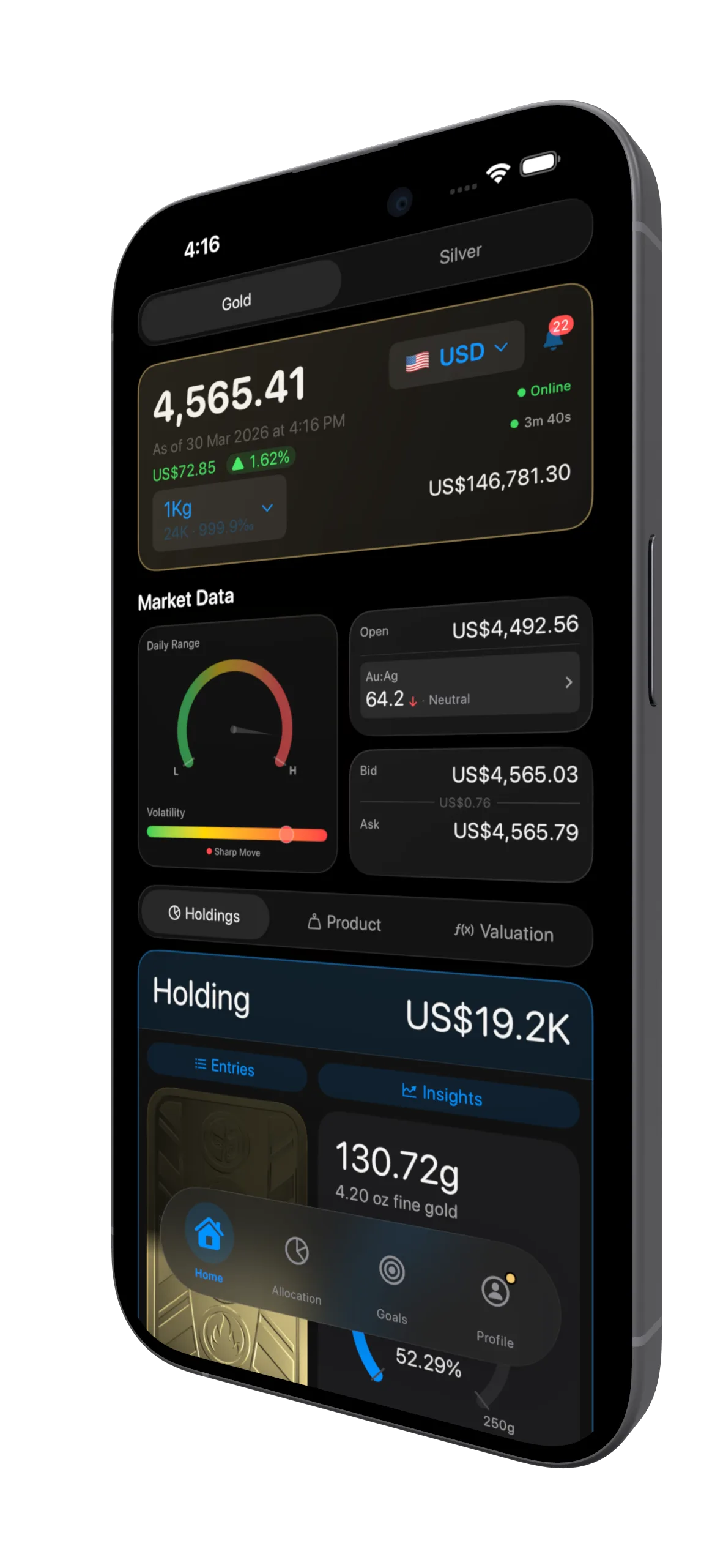
Live Spot Prices
Historical gold spot prices sourced from LBMA and World Gold Council public data. Central bank purchase figures from WGC annual reports. DCA comparisons reference our 10-year backtest.
Past performance does not guarantee future results. This is educational content, not financial, investment, or tax advice. The information presented reflects historical data and the author's interpretation — it is not a recommendation to buy, sell, or hold any asset.
Always do your own research and consult a qualified financial professional before making decisions about your money.